


Hey there! I'm a 1-Butanol supplier, and today I wanna chat about how we can separate 1-Butanol from other substances in a mixture. It's a crucial process in our line of work, and I'm excited to share some insights with you.
First off, let's understand what 1-Butanol is and why separating it matters. 1-Butanol, also known as n-butanol, is a four-carbon alcohol with a wide range of applications. It's used in the production of plastics, coatings, solvents, and even as a biofuel. When we produce 1-Butanol, it often comes out as part of a mixture with other chemicals, and we need to separate it to get a pure product that meets the high - quality standards our customers expect.
One of the most common methods for separating 1-Butanol is distillation. Distillation is a process that takes advantage of the different boiling points of the substances in a mixture. 1-Butanol has a boiling point of around 117 - 118°C. So, if we heat the mixture, the substances with lower boiling points will vaporize first. We can collect these vapors and condense them back into a liquid, separating them from the 1-Butanol.
Let's say we have a mixture of 1-Butanol and water. Water boils at 100°C, so when we heat the mixture, water will start to turn into vapor before 1-Butanol. We can set up a distillation apparatus with a heating source, a distillation flask, a condenser, and a collection flask. As the water vaporizes, it travels through the condenser, where it cools down and turns back into a liquid, which we can collect separately. As the temperature rises to around 117 - 118°C, 1-Butanol starts to vaporize, and we can collect it in a different flask. This way, we can get a relatively pure sample of 1-Butanol.

However, distillation isn't always that straightforward. Sometimes, the substances in the mixture can form azeotropes. An azeotrope is a mixture that has a constant boiling point and distills without a change in composition. For example, 1-Butanol and water can form an azeotrope at a certain composition. In such cases, simple distillation won't give us a completely pure 1-Butanol. We might need to use a more advanced form of distillation called azeotropic distillation. In azeotropic distillation, we add an entrainer, a third substance, to the mixture. The entrainer changes the vapor - liquid equilibrium of the mixture, allowing us to break the azeotrope and separate the 1-Butanol more effectively.
Another method we can use is extraction. Extraction involves using a solvent that selectively dissolves one of the substances in the mixture. Let's assume we have a mixture of 1-Butanol and some non - polar organic compounds. We can choose a polar solvent like water. 1-Butanol is somewhat soluble in water due to its hydroxyl group, while the non - polar compounds are not. We add the water to the mixture and shake it well. The 1-Butanol will dissolve in the water layer, and the non - polar compounds will stay in the organic layer. Then, we can separate the two layers using a separatory funnel. After that, we can recover the 1-Butanol from the water layer, for example, by distillation to remove the water.
We can also use adsorption to separate 1-Butanol. Adsorption is a process where a substance (the adsorbate) adheres to the surface of another substance (the adsorbent). There are special adsorbents like activated carbon or zeolites that can selectively adsorb 1-Butanol from a mixture. We pass the mixture through a column filled with the adsorbent. The 1-Butanol will stick to the adsorbent, while the other substances will pass through. Later, we can desorb the 1-Butanol from the adsorbent by changing the conditions, such as temperature or pressure, and collect the pure 1-Butanol.
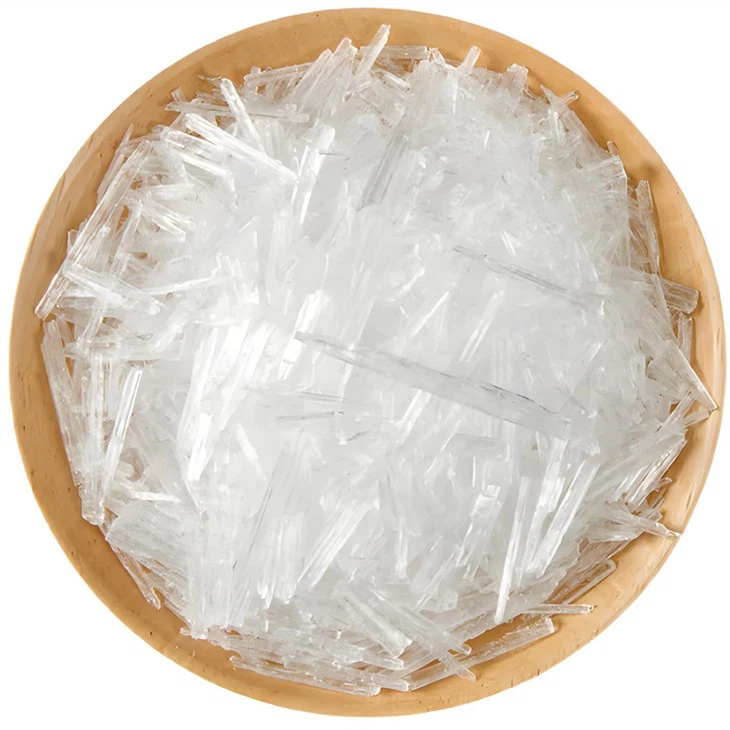
Now, when it comes to the products we offer as a 1-Butanol supplier, we also have a range of other high - quality chemicals. For example, we have China Factory Supply 99% Fraistone CAS 6290 - 17 - 1. This is a great chemical with various applications in the aroma and fragrance industry. We also supply China Factory Supply 99% L - Menthol CAS 2216 - 51 - 5 and China Factory Supply DL - Menthol CAS 89 - 78 - 1, which are widely used in the pharmaceutical and flavor industries.
As a supplier, we're committed to providing the best - quality products. Our separation processes are constantly optimized to ensure that we can offer pure and high - performance chemicals. Whether you need 1-Butanol for your plastic manufacturing process or for making solvents, we've got you covered.
If you're in the market for high - quality 1-Butanol or any of our other products, I encourage you to reach out to us for a procurement discussion. We can talk about your specific needs, the quantity you require, and the price. Our team of experts is always ready to answer your questions and help you find the best solutions for your business.
In conclusion, separating 1-Butanol from other substances in a mixture is a complex but essential process. We use a variety of methods like distillation, extraction, and adsorption to get a pure product. And as a supplier, we're dedicated to delivering the best chemicals to our customers. So, don't hesitate to contact us if you're interested in our products.
References
- Perry, R. H., & Green, D. W. (1997). Perry's Chemical Engineers' Handbook. McGraw - Hill.
- Smith, J. M., Van Ness, H. C., & Abbott, M. M. (2005). Introduction to Chemical Engineering Thermodynamics. McGraw - Hill.


